
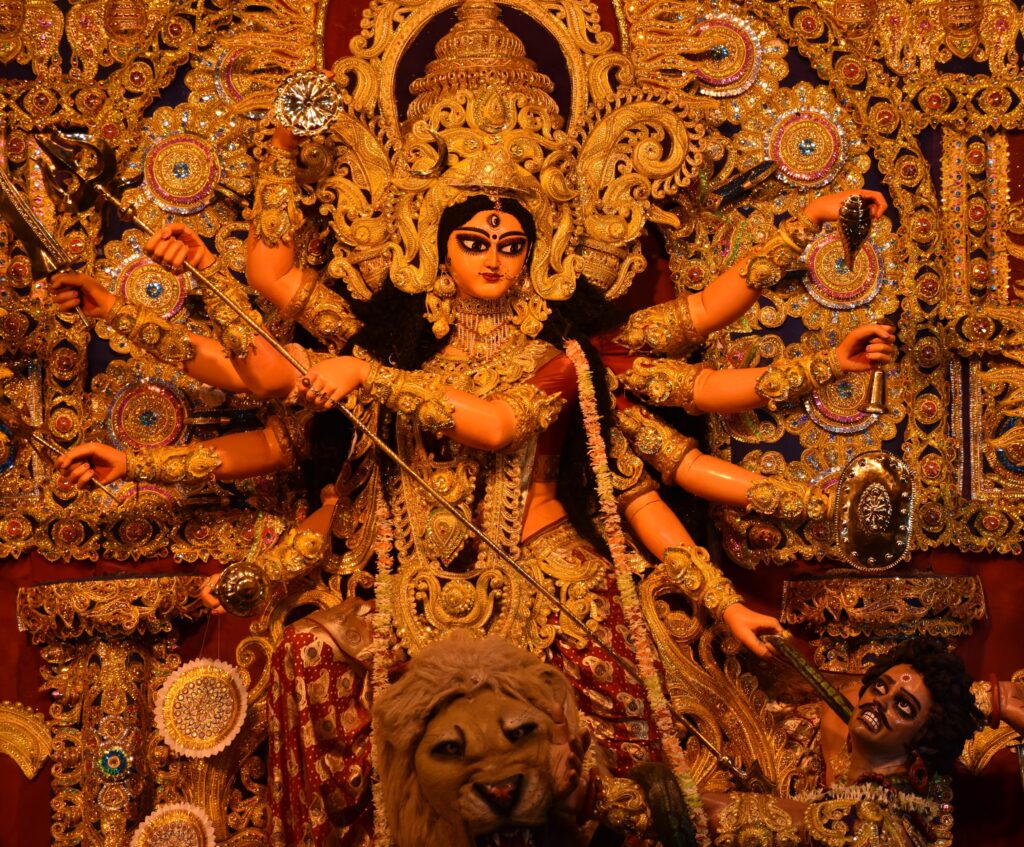
The Divine Navadurga and An Exposition on the Meanings associated with her forms
With all the dazzling lights, and market chaos around the puja pandal would one ever go deeply into the significance and relevance of the meaning that hides behind or is expressed beautifully by the very sumptuous imagery of Maa Durga? The answer is probably, No. In fact all the noise and entertainment helps conceal it. Our heritage and tradition, were they all passed on for the sake of tradition itself or are they in very clear terms trying to tell through the use of all these marvelous imagery and metaphors a goal which humanity must take for itself? So herein we will try to decide exactly that. To reveal the meanings and true significance behind Navami, its rich history in the Subcontinent while also highlighting the tenets of the Shakta traditions, the powerful imagery of the various forms will be the objective of this blog.
Philosophical Underpinnings – Sankhya Yoga lays down certain rules regarding the Nature of reality where the Purusha (consciousness) is seen as separate from Prakriti (Nature). The Prakriti or nature which we are is in a movement towards the ultimate in which nature itself is the ultimate bondage. This Upanishadic concept also stresses the fact that to free oneself from the chains of nature, we can only rely on nature and nothing else. From this arises the feminine connotation of everything natural, in this realm. Not the one pertaining to gender but only the symbolic. This leads to the worship of Nature, the worship of the divine feminine, the Shakta tradition. Shakti or Durga, the symbol of all energy, arises from this very concept. This energy manifests in different ways in the elements of Nature, her animals, plants and all the other living creatures and also in other forms of the Universe itself. Most of the texts about the Devi, available to us, come from the Puranic sources. Durga Saptashati is the most important book which provides us with the material known to us about Shakti and her forms. The general symbolism and imagery associated with her has to be foremost understood. Humans unfortunately have enormous animalistic tendencies, we for millions of years though have evolved materially we haven’t ventured out far from our innate barbarian nature. The Devi when she slays Mahishasura the animal incarnate she symbolises the flowering up of divine tendencies in humans and also the end of the animal in us. The simplistic narrative of good and evil doesn’t go very far though. Both the good and the bad exist in Nature, on a finer plane the act of ridding oneself from the entrapments of nature, the destructive qualities one has, the act of subduing all of them is in fact represented by the Devi through this portrayal. The other important characteristic about Maa Durga is the Abhaya Mudra which she holds, which symbolises fearlessness and courage. In addition to it the very word Durga has been derived from Durg, which means a fort. This gives us the core information about the nature of Devi and the many symbols associated with her. One could also find a slew of weapons amid different other things. This too represents and exemplifies the same fact of courage and infinite energy.
Navadurga during the nine days of Navani is in fact the same Devi but only the progression and different forms of the same divine is worshipped and celebrated. The nine nights of the feminine, each of them is symbolised by an individual form. Now we will talk about it in great detail. The first incarnation of the Devi is Shailaputri. Shailaputri is in fact an embodiment of the supreme power of Brahma and other gods. The raw power of Nature. As most of us would know, the Hindi word Shail is a synonym for Mountain, which is exactly the thing that is being tried to be made known of. Sturdy as a mountain and exemplifying its brute energy and force. In addition to all this she is also the first phase of the divine feminine. The next form is the Brahmacharini, which characterized the devoted and pure phase of Maa Durga. She in this form undergoes spiritual sadhana and penance to make herself available to Grace. The word itself has been derived from Brahmachari which means an individual who is in a spiritual path thus undergoing intense forms of austerity and religious discipline and that is what she is signifying in this form. Abstinence from distractions and other sensual pleasures is the main thing here. The next form is Chandraghanta, the fierce destroyers of demons, the slayer of all our animalistic tendencies. She has 10 hands with different weapons and a water pot and is seated on a tiger. This form also signifies the taming up of the tiger or the violent animal inside of us. How do we come to know of it? Here the imagery is important. We do notice that in every image the Goddess sits atop the animal, whether it is a mule, ass or a tiger. This means an end to the violent, brutal force inside all of us or Nature if we want to call it that. The next is Kushmanda, a very important cause it relates many other mythological concepts too. In the Hindu mythology the universe is imagined in the form of egg or ‘anda’ so the word for universe is Brahmanda or the egg of Brahma, the God of Creation. Within the egg life blossoms due to the presence of warmth and cosmic energy or the shakti. This is the embodiment which we get in the form of Kushmanda, the warmth of life and the egg of creation and the perfect entwining. The progressing phase now is Skandamata, the goddess in her motherhood form. Karti keya is known as Skanda, he is the god of power and victory. This corroborates her triumphing nature, the win over the animal, the demon inside us and the embodiment explains it beautifully. The forms now reach the most destructive and fierce forms of the Devi, the raw, infinite, destructive part of nature. Katyayani, the sixth form of the Divine signifies one of the most fierce forms in which she slays Raktabija, the infinite demon which appears and reappears but eventually she demolishes it. The point of emphasis here is the mind which craves for more and more. She slays that instinct, the violent, bloodlusty mind. The next phase is the even more destructive Kalaratri. The Hindi word Kala means two things: Death and also time. She destroys both of them thus becoming the Goddess of Courage and also auspiciousness, both of the elements if one observes carefully wreak havoc in one’s mind, she destroys both of them providing people with immense courage and zest for life at the same time. She is the darkest and the fiercest form, the male equivalent is the Kalabhairava form of Shiva implying the same exact thing. From the wild nature we come to the most serene, domestic form of Maa Mahagauri, with cow or a white ox as her vehicle symbolising the docile and peaceful implication of this manifestation. Her hair is woven and tied and she is bedecked with jewels and fine clothes, this form is the pinnacle of beauty and peace for both go together. The final form of this progression is Siddhidhatri, the complete form of the divine goddess. The name is derived again from the word Siddhi, the supreme master of the human fold, they almost reach the divine status and that is why that name has been given. The final form is the most perfect manifestation and the characteristic embodiment has been so beautifully represented metaphorically. She sits atop a fully bloomed lotus signifying the completion of the process, the stage of enlightenment and the highest form of the Divine power, the Adi Maha shakti the origin and the finality of the Act of Creation.
This blog tried to explain the meanings behind the numerous symbols of the Devi with her numerous forms. Only now can we learn the process of becoming what the Devi finally becomes, the most beautiful and exquisite in all the acts and only through the understanding of all this can we in true terms rise and reach the highest possible form we can.