
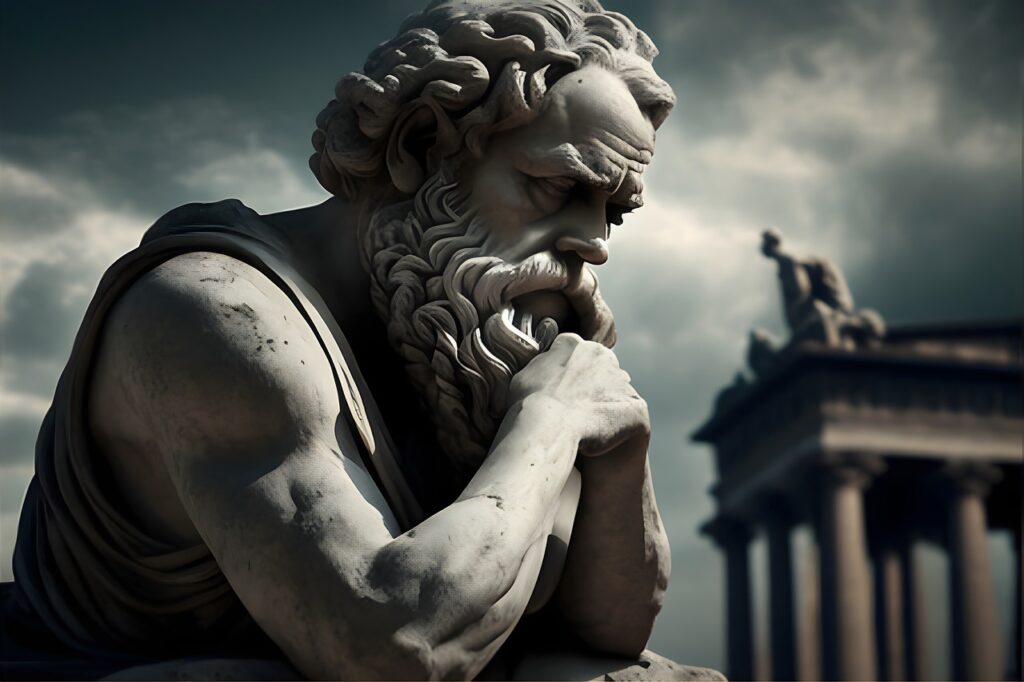
The cultural traits of the Western civilization, its modes, its patterns of behaviour and its whole philosophic discourse can be traced to one man. The man never wrote anything but his insistence on self-examination, his virtue and his eventual execution by the Athenian public is a glory to Mankind’s history. A shiny star of our civilizational whole. We will today investigate as to how the methods of Socrates offended a whole culture and how his process is so wholly relevant especially at a time of great uncertainty in the history of mankind. Today’s consciousness, the whole of it, has been brutally condemned to eternal sorrow and it is visible to us in the vast global epidemic of mental illnesses. The mind of man was never so ignorant about itself even though the vast advancements of Science and Technology would make it look otherwise. Self-examination and inquiry into the self are forbidden, not by the institutions but by the whole culture which means an acceptance of ignorance and which thus invariably leads to conflict and illnesses.
The Socratic Method
Socrates if we observe carefully through the eyes of his pupil, another great philosopher or perhaps the greatest, Plato in his writings and so on which he carefully recorded says that Socrates did not stand on any particular philosophy. He was not at all according to Plato an expounder, his method being that of questioning and learning through dialogue and further questioning and so on. Elaborate theories and professional concepts don’t find expression in his work if we may call it that. His way or the method involved establishing definitions of abstract concepts and then questioning the others in the circle and then questioning them on their responses and in the way proving to them their contradiction which in the very first instance was inherent when the other started the discussion. His method of refutation is discernible and can be wholly comprehended when one actually goes through the process himself or herself albeit a person of the calibre of a wise Socrates is present. He does not stop at proving others insufficient of clarity and rigour but he tests himself ruthlessly through the Method. The opinions he held were constantly put to test as was his moral temperament which comprised subjects of virtue and vice and the like. His own public declaration of ignorance is a sublime highlight of his difference and of his everlasting humility. He was aware of his own lack of knowledge which made an Athenian declare him the wisest person in all of Athens.
Pursuit of Eudaimonia
He posits that all human action is motivated directly or indirectly by eudaimonia or joy or everlasting happiness. Virtue and knowledge he said were linked and a wholesome combination of it could lead to that sense of happiness. Wisdom and sorrow don’t go hand in hand and only when sorrow ceases does wisdom arise. This is what he meant by the linkage of virtue and knowledge.
The label of the Social Gadfly
His nonconformist statements and his poking of the government authorities or the other authorities of Athens made him an unwanted person thus a gadfly. It is not a coincidence but a disgusting habit of humanity that the stars of Mankind have not generally been respected during their lifetimes, they have been prosecuted, tortured and in some instances killed for their unconventional views and life. It happened here with Socrates, it has happened with Jesus, Buddha, the ancient Rishis and so on. Their presence makes the other look non-important and their life meaningless and that is why they can’t believe that someone of the stature that he is, can exist and that is why they run to sling mud on them. His attacks were not in a sense vicious or just for the reason for the purpose of attacking the establishment, they were potent questions and demanded answers of depth. The authorities were uneasy with his confrontational style. He discarded the usual social morality, the mores and the dead tradition his in fact was a life that was active, and not a run of memory as the other Athenians did. This is the entire dichotomy of human existence, the people who understand and the people who don’t. The separation is so very huge that there cannot be any coexistence between these two sets of people. He questioned the social customs of Athenians with all their gods and so on. He said that the sacrifices to the gods were completely useless especially when they are driven by the hope of receiving a reward in return. These were a shocker to the onlookers and to the authorities in general who considered his presence a dangerous thing to the Athenian youth, a public menace so to say.
Seeking Self examination
His entire edifice rests not on gross assumptions and is not in any way swayed by prejudiced thoughts and biases. He demands that ignorance be removed but only when it first has been acknowledged by the true seeker, in other words humility. The ego is an enemy of truth and how to get rid of it, only by an honest self examination which his life was a witness to and his methods, potent instruments of. Asking and answering questions to stimulate critical thinking with an emphasis on the set of virtues like piety, wisdom, temperance, courage and justice. The famous statement attributed to him that ‘Life without examination is not worth living’, is a ruthless slap on our faces because for most people their life is a meaningless drag, a colourless entrapment of suffering and longing. They never even give a single thought to it and Socrates holds a Mirror of truth to these sorts of people.
Moreover his silence and the veil of ignorance he held was in fact a method to make the student question their very assumptions and in the process allow the student to assume the highest level of knowledge. In a way the discipline he taught is the essence of religion, a seeker of the ultimate kind who doesn’t stop at one question or two but is involved in a process which is continuous and therefore exact.
Conclusion
In this day and age when questioning and the pursuit of self knowledge has ceased, it is very important that the spirit of enquiry and examination be brought in the minds of the younger generation, the Socrates and the seeker be unified in a whole in the mind of a person. The relevance of Socrates also burns aflame when anti-authoritarianism is rightfully criticised be it the political or cultural or of a collective mindset which Socrates did and died for ultimately. The acceptance of the status quo is an abominable fact and this pertains to the life of the questioner too. The audacity to pose questions to the ego, the self and the authority one has over oneself is a quality that Socrates has and that is the Socratic essence. It is not a compromise but a confrontation with one’s own evil which in itself is a religious quality. The penchant of his enormous stature lies in his understanding and it alone, and only in our understanding will that Socratic one come alive.